
Cybernx Premier Cyber Security - Cloud Security Service Mumbai
Full Stack Observability: Why Complete Visibility Is the Key to Faster Incident Resolution
Most organizations already have monitoring tools in place. They receive alerts when a server runs out of memory, an application becomes unavailable, or a database experiences high latency. Yet when a real production incident occurs, IT teams often spend hours trying to understand what actually happened. The reason is simple—monitoring data is spread across multiple platforms, making it difficult to connect the dots.
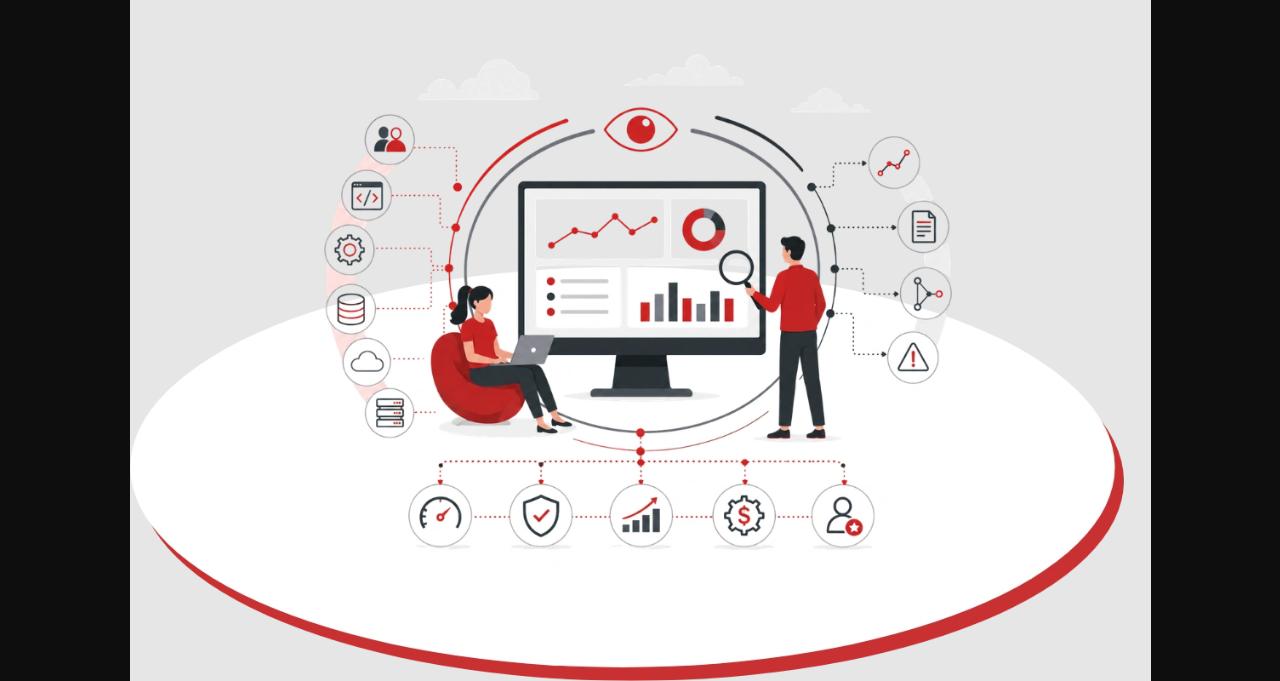
This is why Full Stack Observability has become a priority for modern enterprises. Rather than monitoring individual components in isolation, it provides end-to-end visibility across applications, infrastructure, cloud environments, networks, databases, logs, metrics, and distributed traces. With everything connected, teams can identify the root cause of an issue much faster and reduce downtime before it affects customers.
As businesses continue adopting cloud-native architectures, microservices, and hybrid environments, Full Stack Observability is no longer a luxury. It has become an essential capability for maintaining reliable digital services.
What is Full Stack Observability?
Full Stack Observability is the practice of collecting, correlating, and analyzing telemetry data from every layer of an IT environment. Instead of looking at isolated metrics or individual alerts, observability helps teams understand how every component interacts across the entire technology stack.
A comprehensive observability solution typically provides visibility into:
- Applications and APIs
- Cloud infrastructure
- Virtual machines and servers
- Containers and Kubernetes
- Databases
- Networks
- Logs
- Metrics
- Distributed traces
- End-user experience
This unified approach allows IT and security teams to investigate incidents with complete context rather than relying on assumptions.
Why traditional monitoring falls short
Traditional monitoring tools are designed to answer basic operational questions.
- Is the server online?
- Is CPU usage high?
- Is the application responding?
While these answers are useful, they rarely explain why an issue occurred.
Modern applications consist of dozens—or even hundreds—of interconnected services. A single customer transaction may travel through multiple APIs, databases, cloud workloads, authentication systems, and third-party services before it is completed.
If just one dependency experiences a delay, users may encounter slow response times or failed transactions. Traditional monitoring often identifies the symptom but not the underlying cause.
Full Stack Observability connects logs, metrics, traces, and infrastructure events to provide a complete picture, enabling teams to resolve incidents much faster.
A practical example from the field
I recently came across a discussion where an engineering manager shared an experience that perfectly illustrates the value of observability.
Their company began receiving customer complaints about intermittent payment failures. Infrastructure dashboards showed healthy servers, CPU usage remained normal, and there were no obvious database issues. Every individual monitoring tool suggested that the environment was functioning correctly.
After implementing a Full Stack Observability platform, the team discovered the real problem. Distributed tracing revealed that requests were waiting several seconds for responses from a third-party identity verification service. Those delays cascaded across multiple microservices, eventually causing customer transactions to time out.
Once the dependency was identified, the engineering team optimized request handling and introduced fallback mechanisms. According to the manager, customer complaints dropped significantly, and future investigations became much faster because every service could be traced from end to end.
This example demonstrates why complete visibility is often more valuable than simply collecting more monitoring data.
Benefits of Full Stack Observability
Organizations that adopt Full Stack Observability often experience improvements in both operational efficiency and customer experience.
Some of the key benefits include:
- Faster root cause analysis
- Reduced Mean Time to Detect (MTTD)
- Lower Mean Time to Resolve (MTTR)
- Improved application availability
- Better cloud resource optimization
- Stronger collaboration between development and operations teams
- Improved customer experience
- Better visibility into distributed applications
Instead of responding to isolated alerts, teams can investigate incidents with confidence and make informed decisions based on correlated data.
Common challenges without Full Stack Observability
Organizations relying on disconnected monitoring tools often struggle during major incidents. Different teams investigate different dashboards, resulting in duplicated effort and delayed resolution.
Infrastructure teams may report healthy servers while application teams focus on software logs. Network engineers might find no connectivity issues, and cloud administrators may see no resource constraints. Despite everyone's efforts, nobody has the complete picture.
These fragmented investigations increase downtime, frustrate employees, and negatively impact customers.
Full Stack Observability addresses this challenge by bringing telemetry from every layer into a single platform. Instead of manually comparing information from multiple tools, teams can immediately trace how one event triggered another and identify the exact source of the problem.
This capability becomes increasingly valuable as organizations migrate more workloads to the cloud and adopt complex microservice architectures.
Best practices for implementing Full Stack Observability
Successful implementation involves more than deploying a new platform. Organizations should begin by identifying their business-critical applications and mapping the services that support them.
Next, collect logs, metrics, and traces consistently across all systems. Standardized telemetry ensures data can be correlated during investigations.
Alert fatigue should also be addressed. Rather than creating hundreds of notifications, organizations should configure intelligent alerts based on business impact and service health. This helps operations teams prioritize incidents that genuinely require immediate attention.
Regularly reviewing dashboards, telemetry sources, and alert rules is equally important. As applications evolve, observability strategies should evolve alongside them to maintain complete visibility.
How CyberNX helps organizations improve observability
Many businesses invest in observability platforms but struggle to configure them effectively or transform data into actionable insights.
CyberNX helps organizations implement Full Stack Observability solutions that provide visibility across applications, cloud infrastructure, databases, networks, and enterprise workloads. Beyond deployment, CyberNX assists with dashboard design, telemetry integration, intelligent alerting, and performance optimization so teams can detect issues earlier and resolve them faster.
The objective is not simply to collect more operational data but to help organizations understand what that data means and how it can improve business resilience.
Final thoughts
Technology environments continue to grow in complexity, making traditional monitoring alone insufficient for modern operations. Organizations need visibility that extends beyond individual servers or applications to include every dependency involved in delivering digital services.
Full Stack Observability provides that visibility by connecting logs, metrics, traces, and infrastructure data into a unified view. It enables faster troubleshooting, reduces downtime, improves customer experience, and gives IT teams greater confidence when responding to incidents.
For organizations looking to improve operational resilience and accelerate incident resolution, adopting Full Stack Observability is a strategic investment. With the right implementation approach and an experienced partner like CyberNX, businesses can transform scattered operational data into meaningful insights that support better performance, stronger reliability, and long-term growth.
Contact Address: 11th floor, AT By AGM Vijaylaxmi Venture, Plot 6/7, Mahal Industrial Estate, Mahakali Caves Road, Andheri (E), Mumbai - 400093, Maharashtra, India
Website Url: https://www.cybernx.com/
Details
| Category | Business Opportunities |
|---|---|
| Location | Mumbai, Maharashtra |
| Posted On | Jul 21, 2026 |
When you call, don't forget to mention that you found this ad on PostFreeAds.
Share this ad
Recent Ads
-
 Best Tuition Center in Jaipur in Jaipur for Students | The Miracle Academy Jaipur
 -
 Social Media Marketing Services in Ahmedabad | UV Digital
 -
 Geetech Bricks Machines Manufacturers Coimbatore
 -
 Palande Tours and Travels in Mumbai | Explore Mumbai with Ease
 -
 Gravton Quanta Telangana Hyderabad - India's First Electric Motorcycle With 17-inch Wheels
 -
 OST to PST converter - MailsDaddy New Delhi